Governance & Inspection ReadinessWell-LedCarevia Series · Part Four
The PIR Trap: Why Most Managers Treat the Provider Information Return as Paperwork — and Miss Its Real Power
Published April 2026Reading time: 20 minutesCategory: Governance & Inspection Readiness
This article is the fourth in Carevia’s governance series. The PIR is the only moment in the regulatory cycle when CQC reads your service in your own words before they meet you. Carevia Pro+ members access the PIR Evidence Builder — the interactive year-long companion that turns the PIR from a deadline into a habit. Carevia Pro members get the PIR Monthly Evidence Tracker, a spreadsheet-based companion built for the same discipline. Compare Pro and Pro+ — or join Pro+ now.
What PIR stands for, and why it exists
PIR stands for Provider Information Return. It is the form that every registered adult social care provider in England is required to submit to the Care Quality Commission. It is sent to the registered manager by email, in the anniversary month of the service’s first inspection, with a four-week window for completion. It must be submitted online through a unique link.
That much most registered managers know. The bit they often don’t know is the legal basis: the PIR is required by law under Regulation 17(3) of the Health and Social Care Act 2008 (Regulated Activities) Regulations 2014 — Good Governance. It sits inside the same regulation as systems and processes for assessing, monitoring and improving service quality, audit, and the maintenance of accurate records. The PIR is not a standalone administrative request. It is the regulator exercising its statutory power to ask, in your own words, how you know your service is delivering safe, effective, caring, responsive and well-led care.
For the wider context of what Regulation 17 actually requires — and why Good Governance is the regulation most often misread by registered managers — see CQC Regulation 17: What It Means in Practice.
The form itself is structured around CQC’s five key questions and the quality statements that sit beneath them. It contains both quantitative data — staff numbers, dependency levels, restraint figures, missed visits for community services, medicine errors — and qualitative narrative responses. Most free-text responses are limited to 500 words. Once submitted, the PIR is reviewed by your inspector and used as one source of intelligence among many in CQC’s monitoring of your service.
So far, so straightforward. But the structure conceals a deeper purpose, and that is where most providers get the PIR wrong.
The most misunderstood document in adult social care
There are two failure modes in how providers approach the PIR. They look opposite, but they share a root cause.
The first failure mode is treating the PIR as paperwork. The email arrives. The deadline is four weeks. A registered manager who is already running a service under load opens the form, finds twenty-something free-text questions of up to 500 words each, and reaches for the path of least resistance. They write generic compliance language. They reuse last year’s answers with the dates updated. They describe what they would like the service to be rather than what it is. They submit on time, breathe out, and forget about it for another year.
The second failure mode is treating the PIR as a high-stakes test. The email arrives. The four-week deadline lands on top of a complaint, a safeguarding referral, a staff sickness wave, and the manager freezes. They cancel evenings. They sit with a blank screen. They write, delete, rewrite. They polish answers until the answers stop sounding like the service. They submit, exhausted, and resolve to start earlier next year — which they don’t, because by the time the next PIR arrives the same load is back.
Both failure modes look different on the surface. One produces thin generic submissions. The other produces over-polished defensive submissions. But they share the same diagnosis: both treat the PIR as an event rather than a year. Both wait for the deadline to arrive. Both attempt to reconstruct twelve months of service life from memory in twenty-eight days. Both miss what the PIR actually is.
The PIR is the only moment in the regulatory cycle when CQC reads your service in your own words before they meet you. That is not paperwork. That is the most important narrative opportunity a registered manager has all year.
Inspectors arrive on site with an idea of your service already formed. The PIR is one of the documents that shapes how that idea forms. A thin PIR primes them to dig harder for what’s missing. A strong PIR primes them to test whether what you describe is what they will find. Neither outcome is fair or unfair — it is simply how the inspection process works. The PIR is the document that decides which conversation you start in.
Don’t be caught out by the PIR submission email. Carevia Pro+ members log evidence as it happens and mark the significant moments for their service timeline — so the PIR writes itself. Pro members get the spreadsheet companion built for the same discipline.
Sector commentary about PIRs is full of confident claims about what failure to submit will do to your rating. The reality, when you read CQC’s own published guidance, is more nuanced — and more interesting.
What CQC say in their own words: “We use information in the PIR to monitor services. It is not a pre-inspection document. It can help with planning inspections along with other sources of evidence. Judgements about the overall quality and ratings of services are not based on the PIR. They are based on information gathered across the whole inspection process.”
That statement is worth sitting with, because it contradicts much of what is written about PIRs in the wider sector. The PIR is monitoring information. It feeds into the picture CQC build of your service. It is not, by itself, the document that decides your rating.
What about the Well-Led rating limiter?
You may have read elsewhere that failure to submit a PIR caps your Well-Led rating at Requires Improvement. That claim has a real basis but a complicated present. Under CQC’s pre-2024 methodology, the Provider Handbook listed a small number of circumstances that limited the rating of the Well-Led domain to Requires Improvement, and non-return of the PIR was on that list, alongside failure to submit statutory notifications, not meeting registration conditions, and not having a registered manager in place. Specialist regulatory legal commentary documented the rating limiter mechanism in detail.
Under the Single Assessment Framework introduced in 2024, the position is less clear-cut. The independent review of the SAF by Dr Penny Dash explicitly framed rating limiters as a feature of the previous methodology that supported consistency in judgements — past tense. The CQC’s currently published PIR guidance has dropped the rating limiter language. The framework itself is in transition: the December 2025 CQC consultation proposed reintroducing rating characteristics, and a second-phase review is ongoing through 2026.
None of which changes the underlying point. Whether or not a rating limiter applies in any given inspection cycle, a thin or absent PIR signals something to an inspector — about how a service organises itself, what evidence it can put its hands on, and whether the registered manager treats their regulatory cycle as a discipline or a deadline. The right question is not “what is the penalty if I do not submit.” The right question is “what does my submission, or my failure to submit, say about how this service is run.”
A completed PIR can mask the absence of the evidence it claims to summarise. The form is filled. The submission is on time. The screen says “Thank you for your submission.” Everything looks done.
But the answers were written from memory in a four-week sprint. The audit referenced did not happen, or happened nine months ago. The lessons-learned narrative describes one incident where there were three. The staff supervision schedule described in the form is not the schedule running on the floor. The form is complete. The service it describes is not the service that exists.
This is the False Assurance Problem in its PIR-specific form. Completion masks emptiness. The artefact is intact, current, on time. The assurance it provides to the manager who submitted it — and potentially to the inspector reading it — is not.
The False Assurance Problem is the named pattern that runs through Carevia’s governance series. A governance artefact looks complete. The compliance box is ticked. The folder is current. The submission is timely. But the artefact is not connecting to practice. There is air between what the document describes and what is happening on shift. Leaders, inspectors and reviewers can see assurance where there is only paperwork.
The audit article in this series surfaced it. The policies article surfaced it differently. The PIR is its third, most temporally extended manifestation. The audit can be re-run. The policy can be re-read. The PIR is annual — once it is submitted, the document is locked in, and the next opportunity to demonstrate something different is twelve months away.
The diagnostic question for any PIR is therefore simple: If an inspector asked me to show, in my records and in my service, the evidence behind every claim in this PIR — could I? If the answer is “mostly,” the PIR has a structural weakness. If the answer is “not quite,” it is not the PIR that is the problem. It is the absence of the year of evidence that should have stood behind it.
Even managers who know all of the above tend to find themselves writing PIRs in panic. There are practical reasons for this, and naming them helps explain why the standard “start earlier next year” advice never quite lands.
Anniversary timing is unpredictable in practice
Theoretically, the PIR arrives in the anniversary month of your service’s first inspection. In practice, registered managers move services. Inspections get delayed. CQC’s own systems sometimes send PIRs in different months. Asking a manager to mentally hold “we will probably get a PIR sometime around April” alongside everything else they hold is not a viable preparation strategy.
Four weeks is not enough for a year of evidence
The PIR can require around 8,000 words of qualitative response across all questions, in addition to the numerical data. Twenty-eight days of normal manager workload, plus a PIR, plus whatever else this particular month brings, leaves very little time. Most managers end up giving the PIR perhaps fifteen to twenty hours total, much of it in evenings, much of it from memory. CQC’s own figures cite an average completion time of around seven hours. That is not seven hours of careful evidencing. That is seven hours of trying to remember what happened.
There is no built-in evidence trail
If you have not been logging things as they happened, with dates and attribution, the PIR becomes a memory exercise. The manager who can answer Question 14 — “tell us about complaints, lessons learned and what changed” — has either got a working complaints log they can pull from, or they are reconstructing six months of complaint handling from email threads and post-it notes the night before submission. The form is the same. The manager’s experience of completing it is not.
There is nowhere to draft
The CQC’s own form is not designed for drafting. It is designed for submission. CQC themselves note that the form has, on occasion, failed to save properly, and recommend providers draft answers elsewhere first. Most managers do this in Word, which means there is no link between draft answers and the underlying evidence, no version history, no shared workspace, and no way to capture work in progress over months.
The combined effect of these four pressures is the panic submission. None of them are individually unmanageable. Together, in the four weeks of a normal manager month, they produce the seven-hour PIR — and the False Assurance Problem that ships with it.
Recognise yourself in those four pressures? The Carevia PIR Evidence Builder removes them — anniversary reminder, year-long drafting space, structured evidence sections, RAOF reflection on every entry. Built for Pro+ members.
It is worth being concrete about what good looks like, because most sector advice on PIRs stops at “be honest” and “give examples.” That is correct but unhelpful. Here is the more specific shape of a PIR that lands well with an inspector.
It is specific, dated, and attributed
Generic claims do not earn trust. “We learn from complaints” is a sentence; “in November, three complaints about visit timing led us to review and change our scheduling process — visit complaints have reduced by half over the following three months” is evidence. Inspectors read PIRs to test whether the service describes itself in language they could verify on the ground. Specific, dated, attributed examples make verification possible.
The discipline that produces this is mechanical, not creative. A working evidence log captures three things together: what happened, the date it happened, and who provided the information. Without those three, even a real example reads as memory.
It triangulates across sources
A claim is stronger when it draws on more than one source. “Staff feedback, our last quality survey, and our supervision themes all point to the same issue with handover quality” is a triangulated claim. The PIR question structure invites this — most questions ask both what is happening and how you know. The answers that satisfy “how you know” pull from multiple sources of evidence rather than one.
The discipline of triangulation requires logging the type of each piece of evidence as it arrives — audit, supervision, survey, feedback, incident, observation, near-miss reflection — so that when you reach for examples nine months later, you can see at a glance which claims have one source behind them and which have three.
It includes the difficult things
A PIR that names no problems is not a strong PIR. It is a defensive PIR. Inspectors arrive in services where things have gone well and things have gone badly, and they know that the difference between a well-led service and a poorly-led service is not the absence of problems but the response to them. Naming a complaint, a safeguarding referral, an incident — and then describing what was learned and changed — is a stronger signal than pretending nothing went wrong.
Logging difficult things in the moment is also more honest than reconstructing them under pressure. A safeguarding referral logged in February, with what was learned recorded shortly after, reads differently in a PIR than the same referral remembered, sanitised and rewritten in a four-week sprint nine months later.
It is reflective, not boastful
The temptation in a PIR is to show the service in the best possible light. Inspectors are pattern-detectors; over-polished language reads as performance. A reflective tone — “this is what we tried, this is what worked, this is what we are still working on” — reads as a manager who understands their own service. That tone is more credible, and more useful in the inspection conversation that follows, than a tone of perfection.
Reflection is also easier to capture in small instalments than in 500-word answers under deadline pressure. A single honest sentence about what an entry teaches you about your service, your team, or your own leadership — written when the entry is fresh — reads differently in the PIR than a paragraph constructed afterwards to sound thoughtful.
It connects evidence to outcomes for people
The five key questions are ultimately about the people receiving care. A PIR that describes processes without describing what those processes meant for the people in the service has missed the point. “We changed our medication round timings, and Mary now gets her morning medication before breakfast rather than during it, which she had repeatedly asked for” is a claim about outcomes, not a claim about process.
This is the discipline RAOF most directly supports — the Feedforward question. What changed, or what is changing, as a result? Not “we will action this” — what has actually happened next, and what has it meant for the people in the service.
It builds, over time, into a chronology rather than a list
The strong PIR draws on something most services do not have: a curated record of the year’s significant moments, dated and categorised. Not every entry deserves a place in this chronology — most months produce routine evidence that lives quietly in the relevant section. But across twelve months, around fifteen to thirty entries belong to a different category. They are the moments that tell the service’s actual story: a lesson learned from a complaint, a service improvement made, an example of outstanding practice, an external piece of feedback that landed, a leadership decision that shifted something, a significant incident handled and learned from, a risk identified and managed.
Each of those is a sentence in the year. Together, in date order, they are the answer to the question CQC ask in different forms throughout the PIR: what has changed, what have you learned, and what difference has it made? The manager who can point to that chronology — twelve months of significant moments, attributed and dated, with their source evidence locatable to a folder, system or document — is operating in a fundamentally different conversation than the manager reaching for memory or scrolling through email. It is also the document a successor would inherit if the manager left. Most services do not produce one. The ones that do find that the PIR almost writes itself from it.
This is what Carevia Pro+ members produce naturally, month by month. The PIR Evidence Builder turns the chronology, the categorisation, and the source-locatable evidence into a routine rather than a year-end scramble. Pro members get the spreadsheet companion built for the same discipline.
Everything above points in the same direction. The strong PIR is not written in four weeks. It is built in twelve months. The discipline that produces it is not a writing skill. It is a logging habit.
Carevia’s framework for this is RAOF — Read, Ask, Observe, Feedforward. Each evidence entry, captured at the time it happens, should answer four questions:
Read — what does the data show? An audit, a piece of feedback, a survey, a meeting note.
Ask — who has been asked, and what did they say? Staff supervisions, family conversations, resident voice.
Observe — what has the leader personally seen? A visit, a shift, a moment of practice.
Feedforward — what changed, or what is changing, as a result? Not “we will action this” — what has actually happened next.
RAOF is not designed for the PIR. It is a reflective leadership habit that runs across the whole regulatory cycle. But it produces, as a side effect, exactly the kind of dated, attributed, triangulated evidence that a strong PIR needs. A registered manager who logs one to three RAOF entries per evidence area each month arrives at PIR submission with twelve months of attributable, dated material to draw on — not a blank page.
The other discipline is treating the PIR as a year, not an event. The PIR has eight evidence sections (or seven, depending on service type) plus numbers and stats and a service timeline. None of those need to be written in one sitting. A manager who logs evidence in roughly thirty-five minutes per month, every month, has spent seven hours across the year — the same seven hours the average panic submission takes — but produced something fundamentally different. The same total time, distributed differently, produces an entirely different artefact.
How Carevia helps you build PIR evidence across the year
The Carevia PIR Evidence Builder is the year-long companion that turns the PIR from a deadline into a habit. Built specifically for registered managers in adult social care, it removes the four pressures that produce the panic submission — anniversary timing, the four-week sprint, the missing evidence trail, and the lack of a drafting space.
Eight CQC-aligned evidence sections with structured prompts written like a senior quality lead drafted them — Successes & Barriers, People & Needs, Equality & Rights, Staff, Commissioners, Quality & Risk, Service Settings, Anything Else
RAOF reflection fields on every entry — Read, Ask, Observe, Feedforward built into the routine of evidence capture
Quick Entry button for one-minute capture from anywhere — pick a section, write one sentence, enrich it later
Service-type adaptive — questions and metrics automatically adjust for residential or community (domiciliary, supported living)
Numbers & Stats panel covering everything PIR asks for — restraints, dependencies, staffing, agency hours, missed visits, medicine errors
Service Timeline that builds across the year — categorise significant moments as lessons learned, examples of outstanding practice, service improvements, external feedback, leadership decisions, significant incidents, or risks identified and managed. By PIR submission time, your year reads as a chronology, not a list
Source-locatable evidence — every entry can record where the underlying evidence is stored (folder, system, or document), so when CQC inspect you can drill from the chronology to the proof in seconds rather than searching email for an audit you ran in November
Monthly iCal reminder that lands in any calendar app — a RAOF reflection prompt on the first of every month
JSON backup with 7-day reminder banner, Print/PDF export, and a full Summary view to copy directly into the CQC PIR form
This is not a form-filler. It is a discipline. By PIR submission time, your evidence is already there — and it doubles as the standing evidence base your inspector will look for when they visit.
The interactive PIR Evidence Builder is exclusive to Carevia Pro+ members. Carevia Pro members get the PIR Monthly Evidence Tracker spreadsheet companion, built for the same year-long discipline at a lower tier.
A self-check for registered managers
Six questions to ask yourself before your next PIR
If you cannot answer “yes” to most of these, the PIR is not the problem — the PIR is the symptom. The problem is the absence of the year-long evidence habit that should sit behind it.
Could I show, in dated records, the audit, feedback, supervision or observation that sits behind every claim I would make in a PIR right now?
Would the staff in my service describe the supervision, training and culture in language consistent with what my last PIR described?
Do I have a running record of the complaints, safeguarding referrals and incidents from the last twelve months — not the headline counts, but what was learned and what changed?
Is there a single place I can go to see what happened in this service this month, with attribution and dates, that someone other than me could read?
If I left tomorrow, would my successor inherit a coherent twelve-month evidence trail — or a blank page and a deadline?
When the PIR email arrives, will I open it knowing the work is mostly done, or will I open it and feel my chest tighten?
The chest-tightening response is not a personal failing. It is a structural one. A registered manager who has spent the year running a service rather than building a parallel evidence library is exactly the manager who panics when the PIR arrives. The fix is not more discipline at the deadline. The fix is a different discipline across the year.
The same pattern recurs across four different governance artefacts. In each case, the artefact looks complete while masking absence. In each case, the diagnostic is the same: does the artefact connect to practice, or does it stand alone as paperwork?
The Audit Trap — when a completed audit becomes the assurance, rather than the evidence behind it
Regulation 17 in Practice — what good governance looks like when it is more than a folder of policies
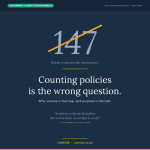
The Policy Volume Trap — when a 147-policy library masks the absence of a single one in working use
The PIR Trap — when a completed PIR submission becomes the evidence, rather than the year of work behind it (this article)
Each of these articles describes a different artefact. Each surfaces the same underlying pattern: completion is not connection. A completed audit is not an assured service. A 147-policy library is not 147 working policies. A submitted PIR is not a year of evidence. The artefact and the assurance it claims to provide are not the same thing.
The discipline that makes the difference is the same in every case. RAOF — Read, Ask, Observe, Feedforward — is the structural triangulation that catches drift between policy, procedure, and practice before the artefact becomes a False Assurance. It is not an audit. It is not a checklist. It is a reflective habit that registered managers can build into the rhythm of their week and their year.
PIR stands for Provider Information Return. It is the annual form that registered adult social care providers in England must submit to the Care Quality Commission, providing structured information about how they meet the five key questions of safe, effective, caring, responsive and well-led. It is required by law under Regulation 17(3) of the Health and Social Care Act 2008 (Regulated Activities) Regulations 2014.
When will I receive my PIR?
The PIR is sent to the registered manager’s email in the anniversary month of the service’s first CQC inspection. CQC may send it in a different month if needed. Once received, you have four weeks to complete and submit. If you have not received a PIR you were expecting, check your spam folder, then contact ASCinspections@cqc.org.uk.
Can I get an extension to the PIR deadline?
Extensions are at the inspector’s discretion, not automatic. You should contact your inspector directly and copy ASCinspections@cqc.org.uk. CQC need to know if an extension has been granted. The CQC’s common PIR queries page sets out the formal process.
Who has to complete the PIR?
The PIR must be completed by the registered manager. Nominated individuals receive a notification but not a separate link. If your registered manager has changed, the nominated individual receives a link to update contact details so the PIR can be re-sent. The form cannot be shared across multiple people drafting at the same time, as this can cause information to be overridden or lost.
Will my Well-Led rating be capped if I do not submit a PIR?
This is more nuanced than sector commentary often suggests. Under CQC’s pre-2024 methodology, the Provider Handbook listed non-return of the PIR as a circumstance that limited the Well-Led rating to Requires Improvement, alongside other governance breaches. Under the Single Assessment Framework introduced in 2024, the position is less clear-cut: the CQC’s currently published PIR guidance has dropped the rating limiter language, and the framework itself is in transition with rating characteristics being reintroduced through a December 2025 consultation. Either way, a thin or absent PIR signals something to an inspector about how a service organises itself — regardless of which mechanism applies in any given inspection cycle.
What if I have multiple service types at the same location?
If you are registered as a dual service location, you receive a separate PIR request for each service type — Residential, Community, Shared Lives, or Specialist Colleges. Each PIR must be completed separately. The questions vary by service type to reflect the different evidence relevant to each.
How long should answers be?
Most free-text responses are limited to 500 words. CQC describe this as a deliberate constraint to keep submissions concise — they will follow up directly if more information is needed. The 500-word limit is enough for two or three specific, dated, attributed examples per question. It is not enough for general claims followed by hedging.
Can I attach supporting documents to the PIR?
No. The PIR does not support attachments. CQC will request additional documents directly if they are needed. The PIR is a standalone narrative submission.
Why do you recommend drafting outside the PIR form?
CQC themselves have flagged that the PIR form can occasionally fail to save properly. Drafting elsewhere first, then copying answers in, protects against data loss. The Carevia PIR Evidence Builder is designed for exactly this — a year-long drafting and evidencing space, with a Summary view at the end that you can copy directly into the live PIR form.
The PIR is not paperwork. It is the only moment in the regulatory cycle when CQC reads your service in your own words before they meet you. Treat it as the year-long discipline it is, and it stops being something to be afraid of. It becomes the artefact you would have written anyway, because you have been writing it all year.
Carevia provides governance and inspection-readiness guidance for registered managers and quality leads in adult social care. This article is not legal or regulatory advice. Specific PIR submission queries should be directed to your CQC inspector or to ASCinspections@cqc.org.uk. References to CQC guidance and the Health and Social Care Act 2008 are accurate at the date of publication; the regulatory framework is subject to ongoing review.