Home › Governance & Inspection Readiness › Safeguarding › What the ITV Blue Ribbon Investigation Should Make Every Care Provider Ask
Governance · Safeguarding · Closed Cultures
What the ITV Blue Ribbon investigation should make every care provider ask
A provider can hold a full set of policies, a completed audit schedule, a safeguarding log and a governance calendar, and still not know what people are experiencing on a Tuesday night. The ITV Blue Ribbon investigation, published on 28 July 2026, describes allegations across several services and several forms of harm. Whatever the outcome of the investigations that follow, the uncomfortable question for every other provider is not whether those systems existed. It is whether leaders knew.
Most boards and management teams cannot answer that question with evidence. They can answer a different one: whether the paperwork was completed. Those are not the same question, and only one of them keeps people safe.
Confidence is not assurance. However, confidence is clever and can disguise itself as assurance.
Carevia gives registered managers, nominated individuals and quality leads a structured way to test the distance between what the records say and what is actually happening in the service.
Pro from £19.99 per month · Pro+ £64.99 per month · Cancel any time
Content note. This article discusses allegations of physical abuse, sexual abuse, neglect, unsafe care and staff misconduct. Some readers may find it distressing. The allegations described are those reported by ITV News. They have not been determined by a court, a regulator or a safeguarding board, and Blue Ribbon Healthcare Group has responded to them. Carevia has not independently investigated any of the events described.
Published: 28 July 2026Approx. 14 minute readGovernance · Safeguarding
What the ITV Blue Ribbon investigation shows about serious failure
ITV News reported allegations concerning care homes and supported living services for adults with learning disabilities, autism and other complex needs. The reporting includes allegations of physical assault and sexual abuse, staff sleeping on shift, cocaine use during a shift, medication given by untrained staff, poor living conditions, and people left without meaningful engagement. ITV spoke to eight people who had worked for the company and to families of several residents.
Blue Ribbon did not deny that incidents took place. It said many of the concerns raised do not reflect the information available to the organisation, or were presented without important clinical, regulatory or factual context, and that other concerns related to historic incidents that were investigated at the time with safeguarding procedures followed and authorities notified where appropriate.
No provider should attempt to determine individual allegations from a news report. That is the job of the regulator, the local authority, the police and the courts. But the shape of the reporting raises a question that travels well beyond one organisation.
When serious failures come to light, providers often describe them as isolated incidents that could not reasonably have been anticipated. Sometimes that is true. No governance system prevents every individual act of misconduct.
What ITV describes is not one unexpected incident. It involves different staff, different services and different categories of harm, alongside concerns about conditions, medication, communication, staffing and oversight. Where concerns appear across several parts of an organisation, leaders have to ask whether warning signs were:
not noticed
noticed but not reported
reported but considered in isolation from each other
explained away
closed without anyone testing whether practice actually improved
or known at senior level, without the action reaching people's daily care
The distinction matters commercially as well as morally. An organisation can show that incidents were recorded, staff were suspended and investigations were opened. Those actions are necessary. They do not, on their own, demonstrate that governance was effective. Effective governance reduces the likelihood of similar concerns continuing, spreading or recurring.
A completed investigation is not proof that learning was embedded. A revised policy is not proof that behaviour changed. An action plan marked complete is not proof that conditions improved.
Governance in action, or governance after the event?
ITV reported an internal email of November 2025 in which the chief executive set out serious concerns about one residential service, including medication errors, poor conditions and incident forms left across an office, and said the service would be at risk of significant enforcement action if the regulator visited. Blue Ribbon told ITV that the email demonstrates governance in action, because concerns were identified, escalated and addressed through its governance processes.
Identifying concerns is part of governance. Escalating them is part of governance. Taking action is part of governance. None of those steps completes the assurance loop.
The loop closes only when a leader can answer:
how long the problems had been present before they were named
why local management systems did not identify or resolve them sooner
whether similar conditions existed in other services
whether staff or families had raised earlier concerns that went nowhere
whether the completed actions changed daily practice
whether the same themes kept appearing afterwards
and whether people became safer as a result
This is where providers substitute evidence of activity for evidence of improvement. It is also where Regulation 17 breaches tend to originate. Inspectors rarely find that a provider had no governance system. They find that the system produced records rather than change.
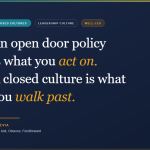
The investigation raises hard questions about what an open door actually looks like from the outside.
An open culture is not demonstrated because relatives can contact the manager, staff can submit concerns, or senior leaders say they welcome feedback. Those are routes. The test is what happens after someone uses one.
Providers who can genuinely claim an open culture can show that leaders:
listen without becoming defensive
look for corroborating evidence rather than a single reassuring account
recognise patterns across complaints, incidents and safeguarding concerns
visit at different times rather than only on planned visits
speak privately with staff, people using the service and relatives
protect those who raise concerns
explain what action was taken
and return later to check that the action changed the person's experience
A service can technically maintain an open door while teaching people that walking through it changes very little. Families keep raising the same concern because they do not feel heard, not because the organisation has failed to send a response letter. Staff go over the head of local management because local management has already failed them. Whistleblowers go external when internal escalation has not produced confidence that anybody is safer.
Do not measure openness by counting reporting routes. Measure it by whether a concern can travel through the organisation without being diluted, delayed or reframed on the way up.
The investigation reports allegations including physical abuse, psychological abuse, sexual abuse, neglect and unsafe staff conduct. Blue Ribbon said safeguarding procedures were followed and relevant authorities and regulators notified where appropriate.
Making a referral where the threshold is met is essential. It is not the end of the provider's responsibility. As set out in Safeguarding: when the policy is not the practice, the work is testing whether the system described in the policy is reflected in staff behaviour, leadership decisions and people's daily lives.
A provider should be able to evidence all of the following, not just the first two:
immediate protection for the person
appropriate referral and regulatory notification
a fair and competent investigation
consideration of other people who may be at risk from the same source
scrutiny of staffing, leadership and organisational factors, not only individual conduct
action taken on the findings
learning shared beyond the service where it happened
follow up evidence showing that risk has reduced
The volume test
Where several investigations run at once, volume becomes a governance issue in its own right. A former quality manager told ITV there were so many investigations happening at one time that there were not enough staff to carry them out. That is a specific, checkable failure mode.
Ask of your own organisation: do we have enough competent people to investigate concerns properly, are delays creating further risk, and do repeated allegations point to something more systemic than individual misconduct?
Read, Ask, Observe, Feedforward
Assurance cannot be built from paperwork alone. RAOF™ is a leadership habit that triangulates three sources of evidence and then sets action going forward. It is not an audit and not a review. It is the discipline of testing whether policy, procedure and practice are still telling the same story.
R
Read
Read past the policy and the headline dashboard. Look at care plans and risk assessments, daily records, incident forms, medication records, complaints, safeguarding concerns, staff suspensions, agency usage, missed activities, environmental checks, restrictive practice records, and the themes that repeat across services.
The point is not to confirm that records exist. It is to find the contradictions. If care plans describe meaningful lives and daily notes show long periods with nothing happening, the records are already telling you something. If audits stay positive while complaints, incidents and suspensions rise, the audit system is measuring completion rather than quality.
A
Ask
Ask questions that cannot be answered with yes, no, or "the policy was followed".
People: Do you feel safe here? What happens when you are unhappy? Do staff understand how you communicate? Are you supported to leave the house and do things you enjoy?
Relatives: Have you noticed changes in wellbeing, health or behaviour? Are your concerns acted on? Do you get clear responses and evidence of improvement? Do staff use the communication guidance you have given them?
Staff: What concerns you about this service? What actually happens when somebody raises a safeguarding concern? Are there shifts, teams or locations where standards are less reliable? What changed after the last incident? What would worry you if a senior leader arrived tonight?
O
Observe
Observation gives you evidence that no audit can. Watch how staff speak to and about people, whether people receive attention and meaningful engagement, cleanliness, medication practice, staff alertness, privacy and dignity, how restrictions are applied, whether communication plans are actually used, and what happens outside planned management visits.
A planned weekday visit shows you a service that expected to be seen. Assurance also has to cover evenings, weekends, nights and periods when agency staff are working. Observation fails when a leader sees poor practice, accepts a reassuring explanation and moves on.
F
Feedforward
Feedforward asks two questions rather than one. Not only what went wrong, but: what must change now, and what will we notice sooner next time?
Actions need to be specific, owned, time bound, proportionate to the risk, shared where the learning applies elsewhere, and checked against subsequent practice. The final test is not whether an action was entered onto a plan. It is whether the person's experience became safer, more dignified and more meaningful.
Test the distance between your records and your service
Carevia Pro gives you the governance library, audits, trackers and supervision tools to build the evidence. Carevia Pro+ adds the Inspection Readiness Dashboard, the RAOF™ Time Planner, and Ask Carevia+ for sense checking the decisions that feel high risk before you make them.
Blue Ribbon told ITV that all of its services which have been inspected are currently rated Good or Outstanding by CQC. That statement is relevant. It also needs reading carefully, and the same care applies to any provider quoting a rating, including yours.
At the time of writing, the CQC profile for Blue Ribbon Supported Living shows the service registered at its present address on 23 October 2023, with no inspection under that registration. The Good rating displayed on the profile predates the move. It comes from an inspection visit on 29 April 2021, reported on 24 May 2021, when the service was registered at 9 to 10 Cross Street in Preston and was supporting 12 people.
That 2021 inspection had a defined scope, set out plainly in the report itself. It was a focused inspection prompted by concerns about care and support at two schemes run by the provider. It reviewed Safe and Well-led only. Ratings for Effective, Caring and Responsive were carried forward from the previous comprehensive inspection, which was published on 1 November 2019.
The evidence base is also stated in the report. The inspection was undertaken by one inspector. Alongside an office visit, the inspector visited one scheme and saw the extent of care and support provided to one person, and was unable to visit the second scheme the concerns related to because of the complex needs of the people living there. The inspector spoke with three staff members, the registered manager and a provider representative, and considered five staff recruitment files, two people's care files, medicines records, and management records including policies and procedures.
None of that invalidates the rating awarded at the time. The inspector found what the inspector found, and reported the scope of the evidence honestly. The point is that a rating cannot be read without that scope attached. Before treating a rating as current assurance, whether it is yours, a competitor's or a provider you are about to place someone with, check:
when the inspection took place
which registration and address it relates to
whether the service as currently registered has been inspected at all
which key questions were assessed and which were carried forward
which schemes or locations inspectors physically visited
how many people's care was directly sampled
and how the organisation has changed since
This matters most in supported living. The 2021 report states directly that CQC does not regulate premises used for supported living, and that the inspection looked at people's personal care and support. People were tenants in houses on residential streets. One registered location may oversee support across several separate properties, and an inspection may not involve a visit to every one. If you are unclear where the regulated activity begins and ends in your own services, resolve it before somebody else resolves it for you: see what counts as personal care in supported living and domiciliary care.
What a positive report can and cannot tell you five years later
There is a harder lesson in the 2021 report, and it is not that the inspector missed something.
Under Well-led, the report records a robust governance framework, quality assurance checks on medicines, care plans and delivered care, issues identified quickly and cascaded to the team, a registered manager with an open door policy, staff who knew how to whistleblow, and a positive and open culture. Under Safe, it records safe recruitment with DBS checks and references, safeguarding systems, and medicines audits detailed enough to give staff clear feedback. It was not an uncritical report: it made a recommendation about COVID-19 testing policy, and it noted that incidents were sometimes only reviewed by senior staff at month end, which the registered manager changed to same day review during the inspection itself.
That is a careful piece of work by one inspector, on one day, at one scheme, about 12 people. It describes a service as it was found in April 2021.
A rating is a photograph, not a live feed. Organisations grow, acquire, restructure, lose the manager who held it together, and take on placements they were not built for. None of that shows up on the profile page.
This is the practical warning for your own organisation. If your last inspection was positive and your service has since grown, changed leadership, changed client group or changed address, that rating is describing a service that may no longer exist in the form inspectors saw. The gap between the rating and the reality is exactly the space where the false assurance problem lives, and nobody outside the organisation will close it for you.
Two things have to be held at once. The absence of a recent inspection does not mean CQC has concluded that current practice is safe. Equally, allegations reported in the media are not a regulatory judgement.
Complex care needs stronger assurance, not broader explanations
The investigation concerns people with learning disabilities, autism, communication needs and other complex support requirements. Complexity is real. It affects staffing, training, communication, clinical input, environmental design and risk management.
Complexity must not become a general explanation for poor outcomes. Where a person cannot easily describe what has happened, communicate distress verbally, or independently leave an unsafe environment, the provider's responsibility increases rather than decreases.
In those services, leaders should expect stronger evidence that:
staff understand and use the person's communication method, not just that training was recorded
distress and changes in behaviour are recognised and interpreted
restrictions are lawful, necessary, proportionate and regularly reviewed
staffing matches assessed need on the actual rota, not the establishment
staff hold the specialist competence the placement requires
family knowledge is treated as evidence rather than opinion
risk is actively reviewed rather than carried forward unchanged
and daily life amounts to more than containment and task completion
That last point is the one most often treated as a nicety. ITV reported people left without meaningful engagement, and it is worth being clear that this is not a comfort issue. A person with nothing to do, in a room where nobody is paying particular attention, is a person nobody is noticing. What meaningful activity actually means, as against a programme of activities, and how inspectors test the difference, is set out in why person-centred care makes everything else simpler.
The more dependent a person is on somebody else noticing that something is wrong, the stronger your noticing systems have to be.
High cost placements need evidence of capability
ITV reported that data supplied by public contract analysts Tussell shows Blue Ribbon Healthcare Group received at least £31 million from local authorities and the NHS on care packages since 2020. One family said their son's placement was invoiced at £12,500 a week.
The amount paid does not determine whether care is good or poor. But a high cost, high complexity placement should be matched by clear evidence that the provider can deliver it. Before accepting a placement, a provider should be able to demonstrate a detailed understanding of the person's needs, suitably skilled and available staff, effective communication support, access to appropriate clinical input, a suitable environment, a realistic transition plan, leadership capacity, and the ability to sustain the placement safely.
The question is not whether the organisation believes it can meet the person's needs. It is how that belief has been tested, and by whom. Once the placement begins, leaders have to keep checking whether the assumptions made at assessment are still true, because placements degrade quietly.
Commissioners need to join the evidence together
Lancashire County Council told ITV that it regarded the findings as extremely serious and was investigating the quality and safety of the provider. ITV also reported a former employee's account that social workers, learning disability nurses and other professionals had raised concerns.
Commissioners cannot directly manage every service they fund. They do need systems capable of bringing together safeguarding intelligence, complaints, placement reviews, contract monitoring findings, hospital admissions, police involvement, concerns raised by professionals, family feedback, placement breakdowns, provider level patterns, and information held by other commissioning authorities.
Where people are placed outside their home area, or several commissioners buy from the same provider, information fragments. Each concern looks isolated from where one organisation is standing. Together, they may show a pattern. A provider can be telling each commissioner that a concern is being addressed while no single commissioner can see the total number, seriousness or recurrence of concerns across the organisation.
Twelve questions to take into your next governance meeting
The useful response to an investigation like this is not reassurance that it concerns somebody else. It is to test your own services against it. Take these into your next governance meeting and require evidence for each answer.
Test your own service
Which of our services would worry us most if we arrived without warning tonight?
Where are complaints, incidents, safeguarding concerns and staff suspensions increasing?
Are investigations completed promptly, and by people with the competence to carry them out?
Are action plans closed because evidence shows improvement, or because the actions were completed?
Can people and relatives point to a specific occasion where raising a concern changed practice?
Do senior leaders know what evenings, nights and weekends are really like here?
Are agency staff receiving effective induction, supervision and oversight?
Are staff genuinely competent to support each person's communication and complex needs?
Do care plans describe the life the person is actually living?
Where have we accepted reassurance without observing practice for ourselves?
Are we relying on an older rating without considering its age and scope?
What will we notice sooner next time?
These are uncomfortable questions. They should be. Governance that only confirms what leaders already believe has no diagnostic value.
The final reflection
The allegations reported by ITV News are serious and require fair investigation by the appropriate organisations. Providers should not treat a developing investigation as though every allegation has been finally determined. They should also resist the easier conclusion, which is that this sort of thing only happens somewhere else.
Serious harm can coexist with policies, audits, ratings, safeguarding logs and action plans. The presence of governance systems does not prove that governance is working. The strongest providers do more than read what should be happening. They ask people what is happening, observe practice for themselves, and follow actions through until there is evidence of change.
Paper may provide assurance. Practice provides the test.
Frequently asked questions
What is the ITV Blue Ribbon investigation?
It is an ITV News investigation published on 28 July 2026 by Investigations Editor Daniel Hewitt, reporting allegations of staff misconduct and neglect across care homes and supported living services run by Blue Ribbon Healthcare Group in the North West of England. ITV spoke to eight people who had worked for the company and to families of several residents. Blue Ribbon responded to the allegations, saying many of the concerns raised do not reflect the information available to it or were presented without important clinical, regulatory or factual context, and that others related to historic incidents investigated at the time. The allegations have not been determined by a court or regulator.
How can a provider tell whether an action plan actually changed practice?
By separating completion from effect. An action is complete when the task is done. It is tested when somebody has checked practice after the change, and embedded when it holds up over time without the manager standing over it. That is the logic behind SMART-TE, which adds Tested and Embedded sign off stages to standard SMART actions. In practice it means returning to the same records, the same staff and the same observation two or three months later and asking whether anything is different. If nobody has been back, the plan records intention rather than improvement.
Is a Good CQC rating evidence that a service is currently safe?
A rating is evidence of what inspectors found, within a defined scope, on a defined date, at a defined registration. It is not a continuing guarantee. Before relying on one, check when the inspection took place, which key questions were actually assessed rather than carried forward, whether the service as currently registered has been inspected, which locations inspectors physically visited, and how much of the service was directly sampled. In supported living especially, a single registered location may oversee support across several properties, and an inspection may not include a visit to each one.
What are the warning signs of a closed culture in adult social care?
Concerns that consistently arrive from outside the organisation rather than through internal routes. Families who repeat the same concern because they have never seen it change anything. Staff who escalate past their line manager. Audits that stay positive while incidents and suspensions rise. Visits that only ever happen on weekday mornings. Long standing staff groups with little external contact. Explanations that are accepted without being tested. Any one of these can be innocent. Several together are a pattern worth investigating properly.
Where does RAOF fit alongside our existing audit schedule?
RAOF sits above the audit schedule rather than inside it. Audits tell you whether the required activity happened. RAOF is a leadership habit for testing whether policy, procedure and practice still align, by reading the records, asking people who are not being prompted, observing what actually happens, and then setting action going forward. It works best as periodic sampling, typically monthly, rather than as an extra field on every form. Applied to every entry on a high volume record, it becomes the kind of paperwork it exists to challenge.
What should a provider do in the week after an investigation like this is published?
Three things, in order. First, an unannounced visit to the service you would least like to be visited tonight, at a time you do not normally attend. Second, a pattern review across complaints, incidents, safeguarding referrals, suspensions and agency use for the last six months, looking for themes rather than counts. Third, take the twelve questions above to your governance meeting and require evidence rather than assurance for each answer. Record what you find, including what you could not evidence.
Know what is happening, not what should be happening
Every provider in this sector holds governance records that look complete. The question is whether yours would hold up if somebody tested them against practice this week. Carevia Pro gives you the library and the structure. Carevia Pro+ adds the interactive tools and senior sense checking for the decisions where getting it wrong is expensive.
Source note. This article responds to allegations reported in an ITV News investigation published on 28 July 2026, reported by Daniel Hewitt with additional reporting by Lili Donlon-Mansbridge. Carevia has not independently investigated the events described. Blue Ribbon Healthcare Group's full response and its qualifications are set out in the ITV report and should be read alongside this article. Information about the previous inspection is taken from the CQC inspection report for Blue Ribbon Supported Living, inspection visit 29 April 2021, published 24 May 2021, which is available in full on the CQC website. Information about the current registration and address is taken from the CQC provider profile as it stood at the date of publication.
GovernanceSafeguardingClosed culturesLearning disability and autismRAOF™
Carevia is not a legal service and this article is not legal advice. It is general guidance for adult social care providers and does not constitute a finding about any organisation or individual named in it. Always refer to official CQC guidance, your local safeguarding procedures and your own professional judgement.
Last updated: 28 July 2026
Test your records against what is actually happeningThe Inspection Readiness Dashboard is included with Carevia Pro+.