Personal care is one of the most commonly misunderstood regulated activities in supported living and domiciliary care.
Some services describe support as personal care when it does not meet the legal definition. Others fail to recognise that the support being delivered has crossed the threshold into regulated personal care. Both errors can create significant regulatory and governance risks.
the number of people declared as receiving personal care
decisions about CQC notifications
how complaints and concerns are handled
the evidence provided during an inspection
whether the provider’s registration reflects what is happening in practice
In the most serious cases, a provider may be carrying on a regulated activity without the required registration.
Understanding who is, and who is not, receiving personal care is therefore not a minor technical question. It is a core governance responsibility.
Why clarity matters
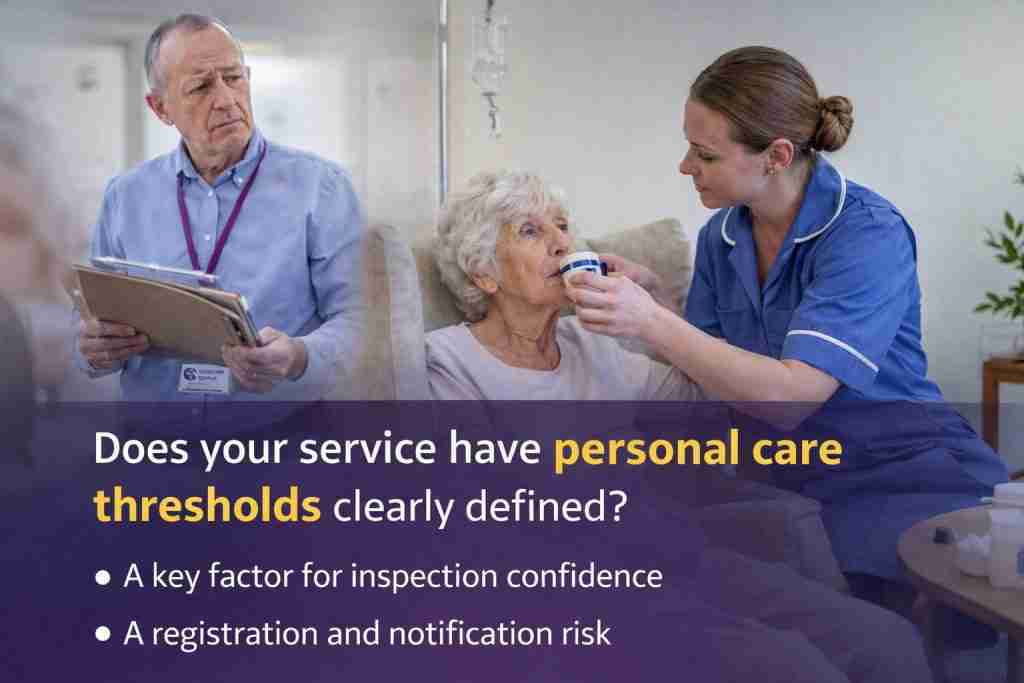
Providers should be able to explain clearly which people receive the regulated activity of personal care, what support staff provide and why that support falls within the definition.
Where this understanding is weak, the same problems often appear:
staff and managers describe the regulated activity inconsistently
more or fewer people are declared than inspectors later identify
care plans do not reflect the support staff actually provide
notifications are submitted unnecessarily or required notifications are missed
evidence is shared that does not align with the service’s regulated scope
changes in people’s needs are not recognised as potentially affecting registration
the provider’s registration no longer reflects the service being delivered
This is why robust care plan and risk assessment reviews matter. A care plan may continue to describe reminders or general support while staff are, in practice, providing physical assistance or direct supervision.
From an inspection perspective, this may raise concerns about how well leaders understand and oversee their own service.
There is also a person-centred reason to get this right. Treating support as regulated personal care when it is not may result in unnecessary intrusion into a person’s private life. Failing to recognise when personal care is being provided may leave people without the regulatory protections that should apply.
The legal definition of personal care
The meaning of personal care is set out in Regulation 2 of the Health and Social Care Act 2008 (Regulated Activities) Regulations 2014. The regulated activity of Personal care is set out in Schedule 1, paragraph 1 of those Regulations.
Personal care includes physical assistance given to a person in connection with:
eating or drinking, including parenteral nutrition
toileting, including menstruation
washing or bathing
dressing
oral care
the care of skin, hair and nails, excluding nail care provided by a podiatrist or chiropodist
It can also include prompting together with supervision in relation to those activities where the person is unable to make the relevant decision without that prompting and supervision.
This distinction is important. Personal care does not only arise where staff physically complete an activity for someone. In some circumstances, the combination of prompting and supervision can also meet the definition.
Prompting and supervision: where the threshold sits
Prompting and supervision are often misunderstood.
For support to fall within this part of the definition, the circumstances must involve more than a general reminder or occasional encouragement. The person must require prompting together with supervision in relation to one of the specified personal-care activities because they are unable to make the relevant decision without that support.
Supervision will normally involve staff directly observing or checking how the activity is being carried out while it is taking place.
Examples that may meet the threshold include:
prompting a person through each stage of washing while remaining present to supervise
reminding a person to complete oral care and directly checking how they do it
prompting and supervising dressing because the person cannot decide how to complete the activity without support
By contrast, the following would not usually meet the definition on their own:
general encouragement
a reminder that it is time to wash or get dressed
leaving a person to complete the activity independently
checking afterwards whether the activity has been completed
The distinction depends on what staff actually do, why the support is required and whether prompting and supervision are both present.
In supported living in particular, independence with proportionate oversight is not the same as dependence requiring regulated personal care.
What does not usually count as personal care?
The following activities do not usually meet the definition of personal care on their own:
general encouragement or motivation
reminders without direct supervision
checking afterwards whether an activity has been completed
cleaning, cooking, shopping or other domestic support
companionship
social support
medication prompts where no regulated personal care is otherwise being provided
However, managers should look beyond the terminology used in care plans. A service may describe support as “prompting”, “oversight” or “encouragement”, while staff are in practice providing physical assistance or remaining present to supervise the activity.
The correct question is not simply what the support is called. It is what staff are actually doing, why they are doing it and whether the support meets the legal definition.
Misclassifying ordinary support as personal care can create unnecessary regulatory confusion. Failing to recognise personal care can be more serious, particularly where the provider’s registration, notifications or inspection evidence no longer reflect what is happening in practice.
Unsure If You’re Delivering Regulated Personal Care?
Small changes in prompting, supervision or support can move a service into CQC scope without being noticed.
Get clear, practical guidance to help you stay compliant, proportionate and inspection-ready.
Medication is not a regulated activity in its own right. For a provider considering whether a person receives the regulated activity of Personal care, medication support alone does not normally bring that person within scope.
For example, a service does not usually need to register for Personal care solely because staff:
remind or prompt a person to take their medication
supervise a person taking their medication
collect prescriptions or order medication
administer medication where no defined personal care is otherwise being provided
However, this does not mean medication is always outside CQC regulation.
Where a provider is delivering personal care to the same person, medication support may be considered as part of that regulated service. Different considerations may also apply where staff undertake clinical tasks that could fall within another regulated activity, such as Treatment of Disease, Disorder or Injury or Nursing Care.
Providers should therefore distinguish between:
medication support provided on its own
medication support delivered alongside regulated personal care
treatment or nursing activity that may fall within another regulated activity
The correct position depends on what staff are actually doing, who is directing or supervising the activity and which regulated activities the provider is carrying on.
Where medication is provided as part of a regulated service, managers must still ensure it is delivered safely and in accordance with the person’s needs, choices and care plan. This includes:
appropriate clinical advice or delegation where required
The key point is that medication support should not be used as a shortcut for deciding whether someone receives personal care. Managers must assess the actual support being provided against the legal definition.
Notifications, regulated activity and proportionality
Registered providers must notify CQC about specified changes, events and incidents. The notification required will depend on the circumstances, the relevant regulation and how the event relates to the service’s regulated activities.
A notification is not simply an internal incident form sent to CQC. It is a statutory regulatory record.
Before submitting a notification, managers should establish:
which notification category may apply
whether the person is receiving a regulated activity from the provider
whether the event occurred during, or relates to, the carrying on of that regulated activity
whether another regulated activity is relevant
what the current CQC notification guidance requires
This is particularly important in supported living services where a provider may support some people with regulated personal care and others with non-regulated social or domestic support.
It should not automatically be assumed that every incident involving a person supported by the organisation must be notified to CQC. Equally, a provider should not decide that an incident is outside CQC’s scope simply because the care plan describes the person as receiving prompts, general support or medication assistance rather than personal care.
Managers should examine what support was actually being delivered and which statutory notification duty, if any, applies.
Good notification decisions should sit within a wider system of accurate incident reporting, escalation and learning. An event may still need to be recorded internally, reported to safeguarding, shared with another professional or investigated by the provider even where a CQC notification is not required.
The key question is therefore not only what information should be shared. It is:
What happened, which regulated activity does it relate to and what reporting or notification duty follows?
Concerns and complaints raised with CQC
CQC does not normally resolve individual complaints about adult social care providers in the same way as a complaints service or ombudsman. However, it receives information and concerns from people, relatives, staff and other organisations and may use that information when monitoring or assessing a provider.
When CQC receives a concern about someone’s care or support, relevant questions may include:
whether the provider is carrying on a regulated activity
whether the person receives that regulated activity
whether the concern relates to the way that activity is being delivered
whether the information indicates wider risks to people using the service
what regulatory action or follow-up is available to CQC
If a provider does not clearly understand which people receive personal care, it may:
give CQC an inaccurate description of the person’s support
provide evidence that does not answer the regulatory concern
blur the distinction between regulated and non-regulated support
overlook wider evidence that staff are providing personal care in practice
respond defensively rather than examining what actually happened
Clarity enables a provider to respond accurately and proportionately while still taking the person’s concern seriously.
Being outside the regulated activity of Personal care does not mean a concern is unimportant. It means the provider must be clear about its own responsibilities, CQC’s regulatory remit and whether another organisation, safeguarding process or complaints route should be involved.
Recognising when personal care is being delivered
The risk is not only describing ordinary support as personal care. Failing to recognise that staff are delivering regulated personal care can be more serious.
This often happens gradually rather than through a single planned decision.
For example:
reminders develop into step-by-step prompting
staff begin remaining present to supervise personal-care activities
a person’s mobility, cognition or decision-making ability changes
staff start physically assisting because it feels safer or quicker
informal support becomes established practice
care plans continue to describe independence while daily practice has changed
A service may therefore cross into regulated personal care without managers immediately recognising it.
This is why robust care plan and risk assessment reviews are essential. Reviews should not rely only on whether staff or the person report a major change. They should examine whether the type, frequency or intensity of support has altered.
Managers should regularly compare:
what the care plan says staff should do
what staff say they are doing
what daily records show
what is observed in practice
what the person now needs to complete the activity
The terminology used in a care plan is not decisive. Calling support “prompting”, “oversight” or “encouragement” does not prevent it from being personal care where staff are actually providing physical assistance or prompting together with supervision.
The correct question is:
What support is being delivered in practice, why is it required and does it now meet the legal definition of personal care?
Registration risk: providing personal care without registration
The regulated activity of Personal care is set out in Schedule 1 of the Health and Social Care Act 2008 (Regulated Activities) Regulations 2014.
Where an organisation is carrying on that regulated activity, it must be registered with CQC unless a relevant exception applies.
The responsibility rests with the provider to understand:
which regulated activities it is carrying on
which people receive those regulated activities
whether any exceptions apply
whether its registration accurately reflects the service being delivered
A provider may be exposed to registration risk where it:
fails to recognise that prompting and supervision now meet the personal-care threshold
allows informal physical assistance to become established practice
continues providing personal care while assuming the service remains non-regulated
delays reviewing its registration after people’s needs or the service model have changed
Carrying on a regulated activity without being registered is an offence under section 10 of the Health and Social Care Act 2008. Depending on the circumstances, CQC’s enforcement options can include a caution, a fixed penalty notice or prosecution.
This is different from receiving a poor inspection finding or breaching a fundamental standard. The registration offence arises from carrying on the regulated activity without being registered to do so.
Providers should act as soon as they identify that their current registration may no longer reflect practice. They should review the activities being delivered, obtain appropriate regulatory advice and consider whether an application to add or amend a regulated activity is required before continuing to provide it.
Inspection risk: more people receiving personal care than declared
During an inspection or assessment, a provider may state that only one person, or a small number of people, receive the regulated activity of Personal care.
CQC may test that account against different sources of evidence, including:
observations of staff practice
conversations with staff and managers
care plans and risk assessments
daily records
information provided by people and relatives
discussions about prompting, supervision and physical assistance
This process may identify that more people receive personal care than the provider has declared.
For example, a care plan may describe someone as receiving reminders to wash or dress, while staff explain that they remain present, prompt each stage and check how the activity is completed. Another person may be described as independent, while daily records show that staff regularly provide physical assistance.
A discrepancy between declared activity and actual practice may raise concerns about:
the provider’s understanding of its regulated activities
whether the provider’s registration remains appropriate
the reliability of information supplied to CQC
The issue is not simply that a number was recorded incorrectly. It may indicate that leaders do not have an accurate understanding of what staff are doing across the service.
When poor understanding becomes a regulatory concern
In one inspection of a domiciliary care provider, CQC stated:
“When we inspected [provider], we found leaders didn’t have a good enough understanding of the service to ensure people were receiving safe care. It was also concerning that staff were providing people with some basic nursing support which the service isn’t registered to do, and the registered manager didn’t know they had to register with us to legally be able to provide this.”
This example concerned basic nursing support and the regulated activity of Treatment of Disease, Disorder or Injury rather than Personal care. It should not therefore be presented as a personal-care prosecution case.
However, the governance lesson is relevant.
Providers must:
understand each regulated activity for which they are registered
know what staff are delivering in practice
recognise when changing needs alter the nature of the service
ensure staff are trained and competent for the activities they undertake
review whether registration remains accurate
Following that inspection, CQC rated the service inadequate, placed it in special measures and began regulatory action. The findings extended beyond registration and included concerns about safety, medicines, consent, staffing, care records and governance.
The example shows how uncertainty about regulated activities can sit within a much wider failure of leadership and oversight. It does not mean that every registration discrepancy will produce the same outcome. CQC’s response will depend on the facts, the risks to people and the provider’s response.
Why personal care can change without being recognised
Personal care presents a particular governance challenge because the threshold may be crossed gradually.
This can happen where:
occasional reminders develop into repeated step-by-step prompts
staff begin remaining present to supervise an activity
a person’s mobility or decision-making ability changes
staff begin providing physical assistance informally
temporary support continues without a formal review
managers rely on care plans that no longer describe current practice
No single member of staff may view the change as significant. However, the combined pattern may show that the person is now receiving regulated personal care.
Where this review identifies unrecognised personal care, the provider may need to address several connected issues:
whether its registration remains correct
whether care plans and risk assessments are accurate
whether staff have the required skills and competence
whether previous incidents should have been notified
whether information provided in the PIR or during inspection was accurate
whether wider governance systems have failed to identify changes in practice
These concerns may affect different parts of CQC’s assessment, particularly leadership, governance, safety and the provider’s understanding of its own service.
Final reflection
Understanding who receives personal care is not about avoiding regulation or reducing the number of people who fall within CQC’s scope.
It is about applying regulation accurately.
Providers should be able to explain:
which people receive the regulated activity of Personal care
what assistance, prompting or supervision staff provide
why that support does or does not meet the legal definition
how changes in people’s needs are identified and reviewed
whether registration and regulatory reporting remain accurate
Getting this wrong can contribute to:
inaccurate care plans and PIR information
inappropriate or missed CQC notifications
questions about leadership and governance
registration action
fixed penalties or other enforcement action
prosecution where a regulated activity is carried on without registration
Providers that get this right do not rely on labels such as “prompting”, “oversight” or “general support”. They examine what staff are actually doing and whether the service has crossed a regulatory threshold.
Ultimately, knowing who is and who is not receiving personal care is fundamental to lawful, person-centred and well-governed service delivery.
Frequently Asked Questions
What is personal care under CQC regulation? The meaning of personal care is set out in Regulation 2 of the Health and Social Care Act 2008 (Regulated Activities) Regulations 2014. The regulated activity of Personal care is set out in Schedule 1, paragraph 1.
Personal care includes physical assistance given to a person in connection with:
eating or drinking, including parenteral nutrition
toileting, including menstruation
washing or bathing
dressing
oral care
the care of skin, hair and nails, excluding nail care provided by a podiatrist or chiropodist
It can also include prompting together with supervision in relation to those activities where the person is unable to make the relevant decision without that support. Does prompting count as personal care? Prompting alone does not automatically count as personal care.
It may meet the definition where prompting is provided together with supervision in relation to one of the specified personal-care activities and the person is unable to make the relevant decision without that support.
General encouragement, reminders without supervision and checking afterwards whether an activity has been completed do not usually meet the threshold on their own.
Managers should consider what staff are actually doing rather than relying only on terms such as “prompting”, “encouragement” or “oversight” in the care plan. What does supervision mean in personal care? Supervision will normally involve directly observing or checking how a personal-care activity is being carried out while it is taking place.
For example, reminding someone that it is time to wash and then leaving them to complete the activity independently would not usually amount to supervision. Remaining present, prompting each stage and checking how the activity is completed may be different.
The decision depends on the person’s needs, why the support is required and what staff provide in practice. Do reminders count as personal care? A reminder on its own does not usually count as personal care.
Examples may include reminding someone that it is time to shower, brush their teeth or get dressed and then allowing them to decide whether and how to complete the activity independently.
However, repeated step-by-step prompts combined with direct supervision may meet the definition where the person cannot make the relevant decision without that support. Is medication a regulated activity? Medication is not a regulated activity in its own right.
A service does not normally need to register for Personal care solely because staff administer, prompt or supervise medication where none of the activities included in the definition of personal care are being provided.
However, this does not mean medication is always outside CQC regulation. Where medication support is delivered alongside personal care, it may be considered as part of that regulated service. Some clinical or treatment activities may also fall within another regulated activity, such as Treatment of Disease, Disorder or Injury or Nursing Care.
Providers should distinguish medication support from delegated healthcare activities and other forms of treatment. Can a supported living service provide medication support without providing personal care? Yes. A supported living service may provide medication support without carrying on the regulated activity of Personal care, provided it is not also delivering activities that fall within the legal definition of personal care.
For example, staff may remind, prompt or supervise someone to take medication without helping them to wash, dress, use the toilet, eat, drink or complete another defined personal-care activity.
The provider must still manage medication safely, maintain appropriate records and ensure staff are trained and competent. How does personal care affect CQC notifications? Notification duties depend on the particular event, the relevant notification regulation and how the event relates to the provider’s regulated activities.
Where a person receives regulated personal care, certain events may need to be notified to CQC. However, managers should not assume that every incident involving someone supported by the organisation must be notified, or that an incident is outside CQC’s scope simply because the care plan describes the support as non-regulated.
Before deciding, managers should establish:
which notification category may apply
whether the person receives a regulated activity
whether the event occurred during, or relates to, that regulated activity
whether another regulated activity is relevant
what current CQC guidance requires
Notification decisions should form part of a wider system of incident reporting, escalation and learning. Should every incident involving someone in supported living be reported to CQC? Not necessarily.
Supported living providers may support some people with regulated personal care and others with non-regulated housing, domestic or social support. Whether a CQC notification is required will depend on the specific event, the regulated activity being carried on and the relevant notification duty.
An incident may still need to be:
recorded internally
investigated by the provider
reported through safeguarding procedures
shared with a commissioner, health professional or another agency
The fact that a CQC notification is not required does not mean the incident is unimportant. What happens if a service does not recognise that it is delivering personal care? If a provider fails to recognise that it is delivering personal care, several connected risks may arise.
These include:
carrying on a regulated activity without appropriate registration
care plans and risk assessments not reflecting actual practice
required notifications being missed
inaccurate information being included in the Provider Information Return
staff providing support without suitable training or competence
inspection concerns about leadership and governance
Carrying on a regulated activity without registration is an offence and can result in enforcement action, including prosecution. What if inspectors find more people receiving personal care than the provider declared? This may raise concerns about whether leaders understand what staff are delivering across the service.
CQC may compare the provider’s account with:
care plans and risk assessments
daily records
staff interviews
observations of practice
information from people and relatives
If these sources show that more people receive personal care than the provider declared, CQC may question the accuracy of the Provider Information Return, the quality of management oversight and whether the provider’s registration remains appropriate. Does this apply to supported living services? Yes. The personal-care threshold is particularly important in supported living because not everyone supported by the provider will necessarily receive a regulated activity.
People’s needs may also change gradually. Reminders can develop into step-by-step prompting, staff may begin remaining present to supervise and occasional physical help can become established practice.
Supported living providers should regularly compare care plans, daily records, staff accounts and observed practice to establish whether support has crossed into regulated personal care. Does this apply to domiciliary care services? Yes. A domiciliary care provider may deliver personal care to some people while providing only domestic, social or medication support to others.
Managers should be able to identify which people receive the regulated activity, what support they receive and whether this is accurately reflected in care plans, contracts, the Provider Information Return and the provider’s registration.
The fact that support is delivered by a registered domiciliary care provider does not automatically mean every person using the service receives regulated personal care. How should managers check whether someone receives personal care? Managers should examine what support is actually delivered rather than relying only on how it is described.
They should ask:
Does staff support relate to one of the activities in the legal definition?
Do staff provide physical assistance?
If not, do they provide prompting together with supervision?
Why does the person require that support?
Do care plans and daily records reflect what happens in practice?
Has the person’s need for support increased or changed?
Does the provider’s registration remain appropriate?
This review should form part of robust care plan and risk assessment reviews. What is the biggest governance risk for providers? The biggest governance risk is not having an accurate understanding of what staff are delivering in practice.
Overstating personal care can blur the boundary between regulated and non-regulated support. Failing to recognise personal care can result in registration problems, inaccurate PIR information, missed notifications and people not receiving the regulatory protections that should apply.
Strong governance requires providers to know:
who receives personal care
what support staff provide
why it meets or does not meet the legal definition
how changes in need are identified
whether registration remains aligned with practice