Carevia Knowledge Centre · Professional curiosity and assurance
What is professional curiosity in adult social care?
Professional curiosity in adult social care means asking questions,
looking beyond the first explanation and connecting information to
understand what is happening for the person. It involves listening,
checking assumptions and exploring whether records, conversations
and everyday practice tell a consistent story.
It can be easy to accept a reassuring answer during a busy day.
A care plan has been reviewed, staff have completed training or an
incident has been discussed at a meeting. However, there are still
questions to ask. Does the care plan reflect the support being
provided? Can staff apply their training? What changed after
the incident?
Professional curiosity helps you explore those questions. You are
asking to understand, identify what needs attention and work
together to improve care.
Is professional curiosity only a leadership responsibility?
Professional curiosity is often discussed in relation to leadership,
safeguarding and investigations. However, care workers, domestic
staff, catering colleagues and others may notice something important
long before it reaches a manager.
A care worker might notice that someone needs more help with their
breakfast. A domestic colleague might hear a comment that leaves
them uncomfortable. Someone preparing meals might notice that food
is regularly returned untouched.
Each person holds part of the picture. They need to understand why
their observations matter, feel able to ask questions and know how
to share concerns.
The Noticing Model™ gives staff at all levels a structure for professional curiosity
through Notice, Recognise, Respond, Report and Reflect.
It helps teams carry an observation through to an appropriate
response and learning.
How does professional curiosity support safeguarding?
Some safeguarding concerns are obvious. Others emerge through small
changes, inconsistencies or routines that nobody has questioned
for some time.
Someone appears uncomfortable around a particular worker. Staff
explain that they are “always anxious”. That may be relevant,
but does it explain why the person seems comfortable with other
colleagues? What does the person say? How do they communicate
discomfort? Has anything changed?
Being professionally curious means considering different explanations
and checking whether they fit the information available. It also
means recognising when immediate protective action or escalation
is needed.
Our article on safeguarding in care homes explores this through an early-morning routine. A person’s history
of getting up early might help explain their preference, but it
does not replace asking what they want today.
Staff should not wait to establish the full picture before reporting
a concern. Questions should support appropriate action and must
not delay protection or compromise safeguarding enquiries.
How should professional curiosity be used when auditing?
An audit can confirm that a document exists without establishing
whether it guides safe, person-centred care.
For example, a falls risk assessment is current, signed and has
been reviewed after an incident. It would be easy to mark that
requirement as met. However, what did the review change? Does it
reflect the person’s current mobility? Can staff explain the
support needed? Is the agreed equipment available and being used?
Professional curiosity helps the auditor explore the evidence behind
the answer. A completed review date is a starting point for checking,
rather than assurance that the assessment is effective.
Read the care plan, risk assessment and relevant records together.
Look for changes, contradictions and missing information.
If daily notes describe increasing difficulty standing, does the
moving and handling plan reflect this? If there have been repeated
falls, do the records show how the service responded and whether
further advice was sought?
Ask
Ask the person about their experience and invite staff to explain
how they provide support. Use open questions that help you
understand their reasoning.
“How do you support this person when they stand?” will usually
tell you more than “Have you read the moving and handling plan?”
Explore what staff would do if the person needed more assistance
than usual.
Observe
Observe whether support reflects the plan, the person’s preferences
and relevant professional advice. Respect the person’s consent,
privacy and dignity, and ensure the person assessing practice is
competent to do so.
A plan may describe someone choosing when to get up, while practice
shows that everyone follows the same morning routine. That
difference needs to be understood.
Feedforward
Use what you find to agree what needs to happen next. This may
include recognising good practice, clarifying a plan, obtaining
advice, arranging coaching or addressing an immediate risk.
Record actions and decide how you will check their effectiveness.
Where one discrepancy is found, consider whether the same issue
could affect other people, staff or shifts. The scope of further
checking should reflect the risk and findings.
The value of RAOF™ comes from connecting the evidence. Where
records, conversations and observations differ, explore why
before reaching a conclusion.
How does professional curiosity strengthen lessons learned?
An incident review may establish what happened and identify an
action for the person involved. Professional curiosity also asks
what the event tells you about the wider service.
For example, a person misses a prescribed medicine because it is
unavailable. The service obtains a supply and reminds staff about
ordering. The immediate problem may have been addressed, but
there is more to understand.
When was the low stock first noticed?
Who was responsible for following it up?
Was the issue handed over between shifts?
What advice was sought about the missed medicine?
Could the same ordering or escalation gap affect other people?
Have similar issues appeared in previous incidents or audits?
A reminder may be appropriate, but it will have limited value if
the underlying difficulty is unclear responsibility or a system
that records an omission without prompting follow-up.
Professional curiosity helps you decide how widely the learning
needs to be applied. It might lead to checking other medicines,
reviewing handover arrangements or testing whether staff know
what to do when a supply cannot be obtained.
Our article on six lessons-learned myths explores why recording an incident, discussing it and completing
an action do not, on their own, establish that learning has
changed practice.
How do I know the learning has made a difference?
Ask what evidence would demonstrate improvement for people
receiving support.
If the action is to strengthen medicines ordering, you might
check whether low stocks are identified early, follow-up is
recorded and unresolved issues reach the next shift. Later checks
can establish whether the improvement continues across different
staff and working days.
Use SMART-TE™, including Tested and Embedded, to build
those checks into your action plan. Closing the loop on actions means following improvement through and checking whether it lasts.
If the same concern returns, be curious about that too. Was the
original cause understood? Was the action achievable? Did staff
have the time, equipment and support needed to put it into practice?
What can get in the way of professional curiosity?
Busy shifts, confidence, hierarchy and previous experiences of
raising concerns can all influence whether someone asks
another question.
Familiarity can also make something seem acceptable. A routine
may have continued for years, or a respected colleague may offer
an explanation that nobody feels comfortable exploring.
The Noticing Model™ identifies four traps that teams can reflect on:
Trust: accepting an explanation because of who provided it.
Assumption: filling a gap without checking.
Familiarity: overlooking something because it has become normal.
Reassurance: allowing a comforting answer or completed record to end
the enquiry too soon.
Trust and experience are valuable. The question is whether they
are being supported by evidence or replacing the need to check.
How can The Noticing Model™ help staff use professional curiosity?
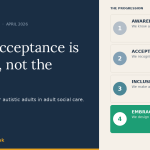
The Noticing Model™ provides a shared structure that can be used in everyday care,
handovers, supervision and learning conversations.
The Noticing Model™ · A public overview
Professional curiosity at every level
A shared structure for carrying what staff notice into an
appropriate response and learning.
01
Notice
What did you see, hear or find missing? Has something changed?
02
Recognise
Why might it matter? What other information helps you understand it?
03
Respond
What needs to happen now, within your role? Is help or advice needed?
04
Report
Who needs to know? How will the information reach them?
05
Reflect
What have you learned, and what will you notice sooner next time?
Professional curiosity connects the person’s voice, records and
everyday practice. Do not wait for a complete picture before
taking necessary action or reporting a concern.
A member of staff does not need to conduct an investigation to use
professional curiosity. They can notice a change, ask an appropriate
question, provide support within their competence and report
what they have found.
Managers then need to respond in a way that encourages staff to
keep sharing information. An observation that turns out to have
a straightforward explanation can still have been worth raising.
How can managers encourage professional curiosity?
Make questions part of normal working conversations. Invite staff
to explain what they noticed, what they thought it meant and
what happened next.
Use supervision and team discussions to explore examples without
making people feel they should already have known every answer.
Recognise occasions when a colleague noticed something early,
challenged an assumption or sought advice.
Check whether staff can question established routines and raise
concerns about senior colleagues. An open-door policy needs to be reflected in how people are received and how concerns
are followed through.
Professional curiosity also needs time and support. If staff are
expected to move continuously between tasks, consider where they
have opportunities to observe, listen, discuss uncertainty
and reflect.
How can The Noticing Walkaround™ help?
The Noticing Walkaround™ gives managers and colleagues a structured way to explore people’s
experiences during a walkaround. It helps them connect what they
observe with conversations and relevant records, consider what
the evidence means and capture actions or good practice that
deserve recognition. This supports professional curiosity beyond
simply recording what the environment looks like.
Someone sitting on their own may be enjoying some quiet time.
They may also want company, need support to join an activity or
find the room too noisy. Professional curiosity means speaking
with the person and checking what support they want, rather
than deciding from a glance.
Use what you see and hear alongside care plans, staff explanations
and the person’s preferences. Where the information does not fit
together, explore the difference and agree any support, action
or follow-up needed. Address immediate concerns promptly rather
than waiting until the walkaround is complete.
The question to keep asking is: “Does what we are being told make sense when we bring the
person’s experience, records and practice together?” Where it does not, there is something further to understand.